

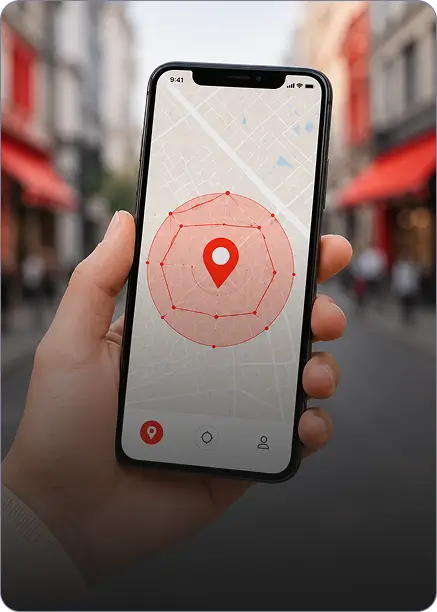
Geofencing advertising draws a virtual boundary around a physical location, like a competitor’s store or an event venue. When someone’s smartphone enters that boundary, they join an audience you can then show ads to across apps and websites. You are targeting people by where they physically went, not by what they searched.
That is the whole concept. The interesting questions are what it costs, when it beats other targeting, and when it burns money. This post covers all three, including the part most vendors skip.
How does geofencing advertising actually work?
A geofencing platform uses GPS and location signals from smartphones to detect when a device enters a mapped zone. The device joins an audience list, and ads follow that person afterward in the apps and mobile sites they already use. The person does not see an ad the moment they cross the line. They see your ads over the following days and weeks.
The mechanics that matter when you buy it:
- Drawing the fence. Good platforms trace the actual building footprint with a polygon accurate to a few meters. Weak ones drop a wide radius pin that swallows the parking lot, the road, and the businesses next door. This single detail separates useful campaigns from wasted ones.
- Qualifying the visit. Serious setups require dwell time, often 5 to 15 minutes inside the fence, so you capture real visitors instead of people driving past.
- Serving the ads. The audience sees your display or video ads through programmatic exchanges afterward, wherever they browse.
- Measuring conversions. A second fence around your own location counts how many people who saw ads later walked in. Foot traffic attribution is geofencing’s best trick; few channels can connect an ad to a physical visit this directly.
What can you target with a geofence?
Four target types cover almost every use case: competitors, events, complementary businesses, and your own past visitors. Competitor conquesting is the workhorse. Someone who spent twenty minutes at a rival dealership, med spa, or showroom is verified in-market, which is targeting quality that keyword and interest data cannot match.
Events are the second big play: conferences, festivals, sports venues, anywhere your buyers concentrate for a day. Fence the venue during the event, and you can market to that audience for weeks after everyone goes home. Complementary businesses round it out. A home remodeler fencing tile showrooms, or an injury clinic fencing gyms, reaches people mid-decision without outbidding anyone on Google.
For a Central Florida example: Orlando hosts more than a thousand conventions and trade shows a year, which makes event fencing unusually productive here. A B2B company can build an audience from one week at the Orange County Convention Center that would cost far more to assemble through LinkedIn ads.
How much does geofencing advertising cost?
Campaigns at Upwynn typically start around $2,500 per month, and most small business programs land in the $2,500 to $10,000 range depending on how many locations you fence and how much of the audience you want to reach. Geofencing is bought on impressions like other programmatic display, so cost scales with audience size and frequency rather than clicks.
The budget math is simple: a fence around three competitor locations in one metro produces a finite audience each month. Spending $10,000 against it mostly buys repetition, not reach. This is a channel where mid-size budgets are often the efficient ones. If you are still setting the overall number, our guide to small business marketing budget percentage is the place to start before splitting it across channels.
Expect results to look like display, not search. Click rates are low. The value shows up in store visits, branded search lift, and conversions attributed over the following weeks, which is why the foot traffic measurement matters more than the click column. If a vendor sells geofencing on click-through rate, keep your hand on your wallet. And if you want the deeper version of how we build these campaigns, our geofencing advertising service page covers the targeting and measurement setup in detail.
When is geofencing a waste of money?
When location does not signal intent, geofencing is the wrong tool. Five situations where we tell businesses to skip it:
| Situation | Why it fails |
|---|---|
| You sell online only, nationwide | Physical visits do not predict purchase; broader programmatic or social targeting reaches the same people cheaper |
| Your customer decides instantly (gas, coffee, convenience) | The ad arrives days after the decision moment already passed |
| The fence location has mixed traffic (malls, strip plazas) | You pay to reach shoppers of forty stores to catch visitors of one |
| Your monthly budget is under ~$500 | Below minimum viable impressions, frequency is too thin to register |
| You need leads this week | Geofencing builds and works an audience over weeks; search captures demand today |
The honest summary: geofencing is a precision awareness channel for businesses whose customers physically go places that reveal intent. It multiplies a strategy; it is not one by itself. It pairs best with paid search capturing the demand it creates, the same way we pair channels in a full media buying plan.
How do you know if a geofencing campaign is working?
Ask for three numbers every month: qualified impressions served, foot traffic conversions from the fence around your own location, and cost per verified visit. Those connect spend to physical outcomes. Everything else is supporting detail.
Give it 60 to 90 days before judging. Audiences accumulate, and attribution windows for a store visit run weeks behind the first impression. If after 90 days the cost per visit is worse than what paid search delivers for the same money, move the budget. That is the same discipline we apply in a mid-year marketing audit: every channel defends its number or loses its budget.
Two more fit checks before you buy: make sure the platform shows its fences on a map so you can verify the polygons, and confirm you can leave. Upwynn runs geofencing month to month with no long-term contracts, because a channel this measurable should not need a lock-in to keep clients.
FAQ
What is geofencing advertising in simple terms?
It is drawing an invisible boundary around a real place and showing ads afterward to people whose phones were inside it. You target by where people went instead of what they typed into a search bar.
Is geofencing legal?
Yes. Platforms use location data with user opt-ins from apps, and audiences are anonymized device IDs, not names. Regulated industries like healthcare carry extra rules about how narrowly you can target, so work with someone who knows them.
How much does geofencing cost per month?
Most small business campaigns run $2,500 to $3,000 a month. Ours start around $2,500. Cost scales with the number of fenced locations and the impression volume, not with clicks.
How accurate is a geofence?
Polygon-based fences trace a building’s footprint to within a few meters. Radius-based fences are far looser and pick up neighbors and passing traffic, which is the most common source of wasted spend in this channel.
Does geofencing work for service businesses without a storefront?
Yes, often better. A roofer or med spa can fence competitors, supply houses, or events where customers gather. The fence is about where your buyers go, not where your office is.
How long until geofencing shows results?
Expect 60 to 90 days. The audience has to build, see ads at enough frequency, and then act, and visit attribution lags by weeks. Judging it in week three is judging it before it starts.
Written by Liz Mbwambo, Founder + CEO of Upwynn Marketing, an Orlando data-driven agency. Connect with her on LinkedIn.